Subject: (Fluid) particles feels their masses heavier than the actual.
Main conclusion: Particle mass is virtually\(\rho_{P} + C_{VM} \rho\), where \(\rho\) is the density of surrounding fluid, and \(C_{VM} = 1/2\) for sphere.
Key idea Particles must accelerate surroundings, thereby the accelerating motion gives an inertial force.
In this section, a solid sphere moving in an incompressible inviscid fluid is considered. Therefore, let us introduce the velocity potential to express the fluid velocity \(\mathbf{v}\):
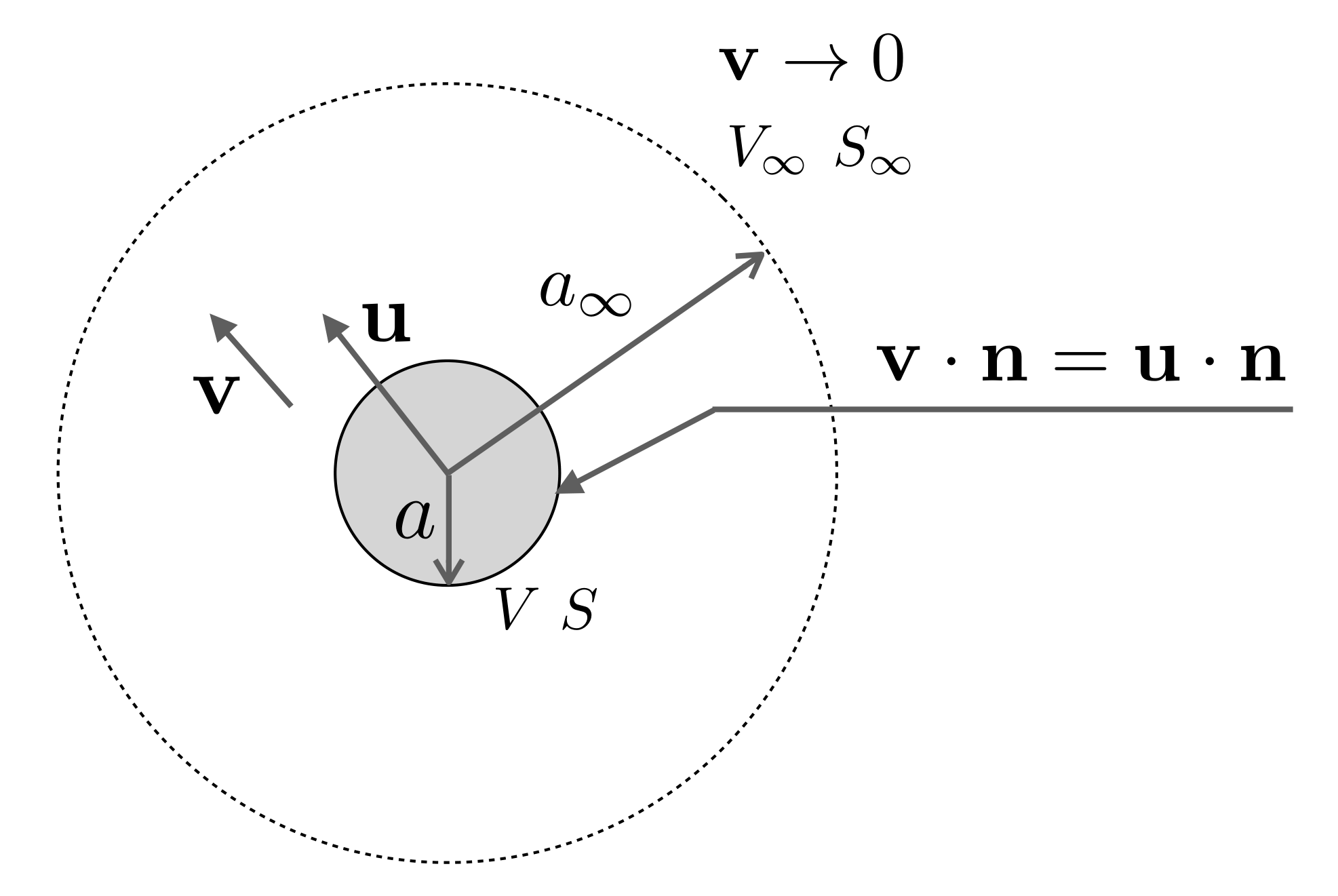
The center of the sphere is set at the origin of the spherical coordinates. At positions far from the sphere, we assume that \(\phi\) is a function of \(r\). \(\phi_{0} = 1/r\) obviously satisfies the Laplace equation:
where \(\mathbf{n}\) is the outward unit normal to \(S_{\infty}\). However, this must vanish because of the incompressibility; therefore, \(\alpha = 0\). The next candidate is \(\nabla \phi_{0}\). Let us therefore set \(\mathbf{A} \cdot \nabla \phi_{0}\), where \(\mathbf{A}\) is a constant vector. The vector component for this velocity potential is given by
In the far field, velocity components given by the velocity potentials of higher order negligibly small compared with \(\mathbf{v}^{(2)}\). Therefore, in the following, we may write \(\mathbf{v}\) instead of \(\mathbf{v}^{(2)}\).
The velocity component normal to the solid sphere \(v_{r}~(= \mathbf{v} \cdot \mathbf{e}_{r})\) must be equal to that of the sphere \(u_{r}~(= \mathbf{u} \cdot \mathbf{e}_{r})\), i.e. the boundary condition \(( \mathbf{v} - \mathbf{u} ) \cdot \mathbf{e}_{r} = 0\).
The total kinetic energy \(E\) of the fluid is given by
(7.10)¶\[ E = \iiint_{V_{\infty}-V} \frac{\rho v^{2}}{2} dV\]
where \(V_{\infty}\) is the fluid volume of a sphere of large size, while its radius will be taken as infinity later to cover the whole system. \(V\) is the volume of the sphere, \(V = 4 \pi a^{3} / 3\). \(( \mathbf{v} - \mathbf{u} ) \cdot ( \mathbf{v} + \mathbf{u} ) = v^{2} - u^{2}\). Therefore, \(v^{2} = u^{2} + ( \mathbf{v} - \mathbf{u} ) \cdot ( \mathbf{v} + \mathbf{u} )\). The integral of the \(v\) square is therefore rewritten as
Since the radius \(a_{\infty}\) of the sphere \(S_{\infty}\) is large, the first term of the integrand is negligible in comparison with the other two terms, so that,
where \(\mathbf{P}\) is the total momentum of the fluid, and the symmetric tensor \(m_{ij}\) is referred to as the induced-mass tensor. Thus, the total kinetic energy of the fluid is expressed as
For the sphere, the induced mass is the half of the fluid mass removed by the sphere.
Consider a spherical particle oscillating in a fluid under the action of an external force \(\mathbf{f}\), which is the source of the change in the total momentum in the system, i.e., the momentum of the fluid and that of the particle. Therefore,
(7.28)¶\[ \frac{d ( M \mathbf{u} + \mathbf{P} )}{dt} = \mathbf{f}\]
where \(M\) is the mass of the particle. Substituting Eq. (7.24) yields
We then consider a spherical particle in a fluid under oscillation. If this particle was the fluid, the momentum of this volume is \(\rho V \mathbf{v}\) and the force acting on the fluid particle of volume \(V\) is given by
where the particle is assumed to be much smaller than the length scale for the spatial change in \(\mathbf{v}\). This volume is actually the particle and may have velocity \(\mathbf{u}\) different from the fluid velocity \(\mathbf{v}\). We therefore need to account for the force due to the relative motion \(\mathbf{u} - \mathbf{v}\):