11.1. Order-of-magnitude analysis for bubble velocity
Summary
Subject: Large bubble in vertical pipe
Main conclusion: Froude number as a function of Reynolds and Eötvös numbers.
Key idea Application of simple order-of-magnitude analysis yields valid functional form of \(Fr\) .
References:
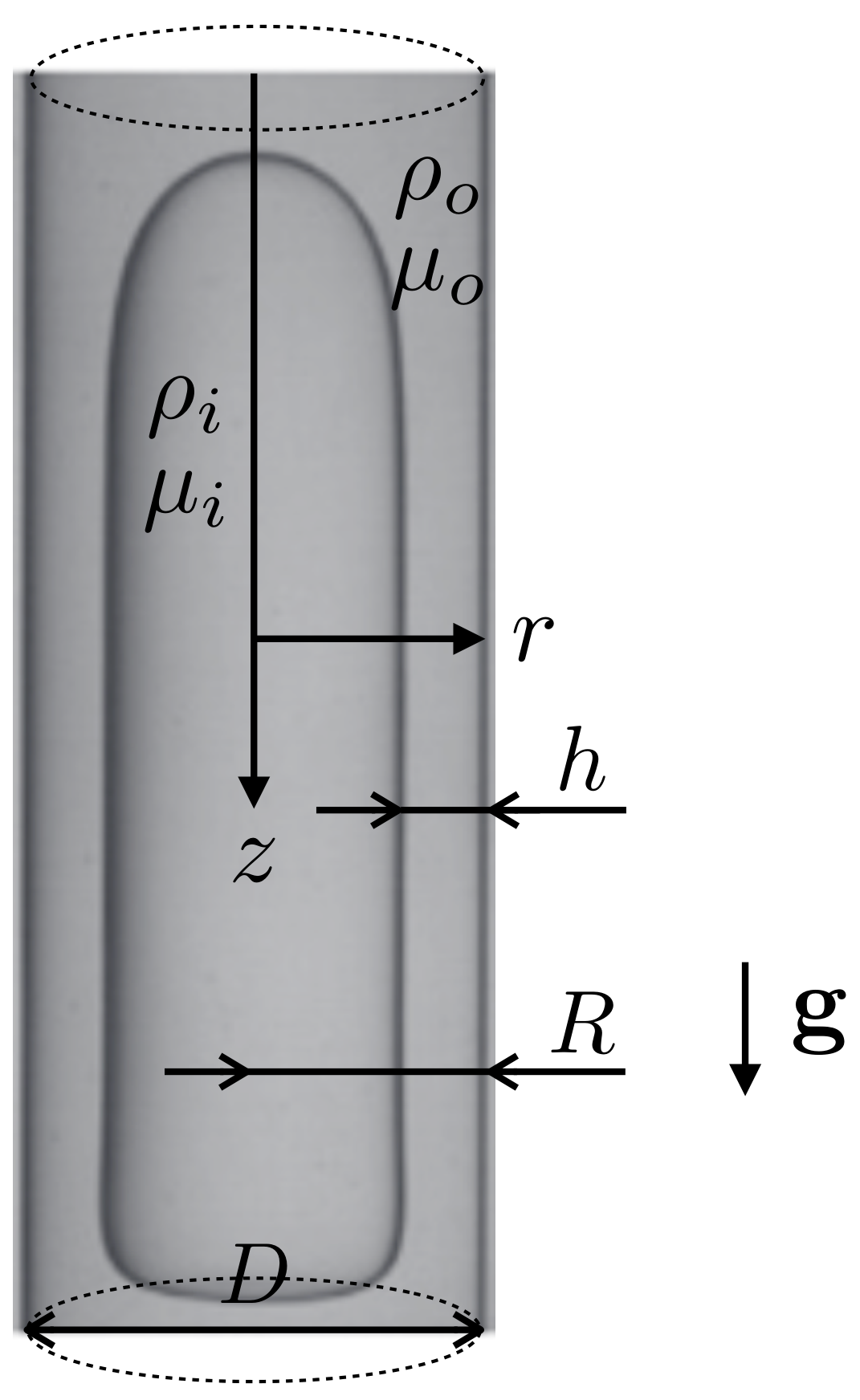
When bubbles and drops of large size flow in a circular conduit, they may take a bullet-like shape due to the constraint of the wall. Due to pioneered work by Davies and Taylor [DT50 ] , bullet-shaped bubbles are termed Taylor bubbles .
An order of magnitude analysis is applied to a Taylor bubble in the following to obtain an velocity expression. The Navier-Stokes equations of the two phases are given by
(11.1) \[ \rho_{k} \mathbf{v}_{k} \cdot \nabla \mathbf{v}_{k} = - \nabla p_{k} + \nabla \cdot \boldsymbol{\tau}_{k} + \rho_{k} \mathbf{g} \]
Evaluating each term in a sense of magnitude , we obtain
(11.2) \[\begin{split}\begin{split}
\rho_{L} \frac{u^{2}}{D} &\sim - \frac{p_{L}}{D} + \frac{1}{D} \left( \mu_{L} \frac{u}{R - h} \right) + \rho_{L} g \\
0 &\sim - \frac{p_{G}}{D} + \rho_{G} g
\end{split}\end{split}\]
Therefore, the pressures are
(11.3) \[\begin{split}\begin{split}
&p_{L} \sim c_{i} \rho_{L} u^{2} + c_{\mu} \mu_{L} \frac{u}{h} + c_{g} \rho_{L} g D \\
&p_{G} \sim c_{g} \rho_{G} g D
\end{split}\end{split}\]
The jump condition in of the momentum in the normal direction is given by
(11.4) \[ p_{G}
=
p_{L} + \mathbf{n}_{L} \cdot \boldsymbol{\tau}_{L} \cdot \mathbf{n}_{L}
+ \sigma \kappa\]
where the curvature in the film region can be evaluated as
(11.5) \[ \kappa \sim \frac{1}{R - h}\]
Substituting the orders of pressure into the jump condition yields
(11.6) \[ c_{g} \rho_{G} g D
=
c_{i} \rho_{L} u^{2} + c_{\mu} \mu_{L} \frac{u}{h} + c_{g} \rho_{L} g D + c_{\sigma} \frac{\sigma}{R - h} \]
In a dimensionless form,
(11.7) \[ 0
=
c_{i} Fr^{2} + c_{\mu} \frac{D}{h} \frac{Fr^{2}}{Re} + c_{g} + c_{\sigma} \frac{D}{(R - h) Eo}\]
where
(11.8) \[ Fr = \frac{u}{\sqrt{ \Delta \rho g D / \rho_{L} }}\]
(11.9) \[ Re = \frac{\rho_{L} u D}{\mu_{L}}\]
(11.10) \[ Eo = \frac{\Delta \rho g D^{2}}{\sigma}\]
Solving the dimensionless form for the Froude number, we have a Froude number correlation of Taylor bubble:
(11.11) \[ Fr = \sqrt{ \frac{c_{1} + c_{3} \frac{D}{R - h} \frac{1}{Eo}}{1 + c_{2} \frac{D}{h} \frac{1}{Re}} }\]
In the limiting case of \(Re \rightarrow \infty\) and \(Eo \rightarrow \infty\) ,
(11.12) \[\begin{split}\begin{split}
&Fr = \sqrt{ \frac{c_{1}}{1 + c_{2} \frac{D}{h} \frac{1}{Re}} } &Eo \rightarrow \infty \\
&Fr = \sqrt{ c_{1} + c_{3} \frac{D}{R - h} \frac{1}{Eo} } &Re \rightarrow \infty \\
&Fr = c_{1}^{1/2} &Eo, Re \rightarrow \infty
\end{split}\end{split}\]
Experiments found that \(c_{1}^{1/2} = 0.35\) and \(\Delta \rho / \rho_{L} \ll 1\) , so
(11.13) \[ u = 0.35 \sqrt{g D}\]
for gas bubbles rising through a low viscosity liquid in a large pipe. A graphical correlation of Taylor bubbles in the entire range of relevant relevant dimensionless groups was given by White and Beardmore [WB62 ] . Readers those who are interested in analytical method on the rise velocity of Taylor bubble, see Funada et al. [FJMY05 ] .
Fig. 11.1 Taylor drop ([HKT11 ] )