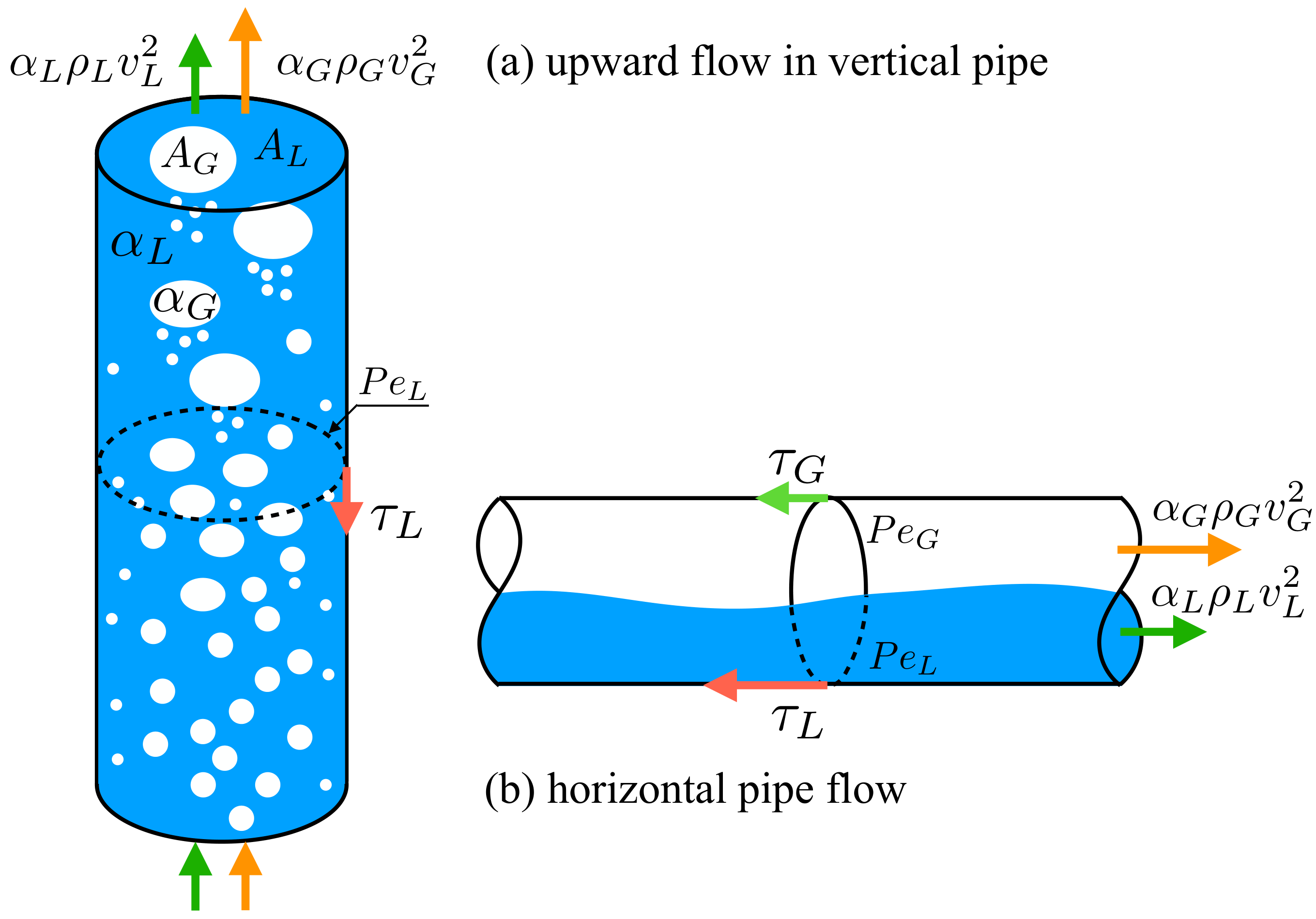
3.1. Global balance in steady upward flowConsider an upward two-phase flow in a vertical pipe (Fig. 3.1
(3.1) \[\begin{split}\begin{split}
&( \rho_{G} v_{G}^{2} A_{G} + \rho_{L} v_{L}^{2} A_{L} )_{+} - ( \rho_{G} v_{G}^{2} A_{G} + \rho_{L} v_{L}^{2} A_{L} )_{-} \\
&=
( - p_{G} A_{G} -p_{L} A_{L} )_{+} - ( - p_{G} A_{G} -p_{L} A_{L} )_{-}
- \tau_{G} S_{G} - \tau_{L} S_{L}
- \rho_{G} g V_{G} - \rho_{L} g V_{L}
\end{split}\end{split}\]
where \(A_{k}\) is the cross sectional area occupied by the phase \(k\) , \(S_{k}\) is the area of the wall in contact with the phase \(k\) , \(V_{k}\) is the volume of the phase \(k\) , and \(g\) is the magnitude of the acceleration of gravity. With the volume fractions,
(3.2) \[\begin{split}\begin{split}
&( \alpha_{G} \rho_{G} v_{G}^{2} + \alpha_{L} \rho_{L} v_{L}^{2} )_{+} - ( \alpha_{G} \rho_{G} v_{G}^{2} + \alpha_{L} \rho_{L} v_{L}^{2} )_{-} \\
&=
( - p_{G} \alpha_{G} -p_{L} \alpha_{L} )_{+} - ( - p_{G} \alpha_{G} -p_{L} \alpha_{L} )_{-}
- \tau_{G} \frac{S_{G}}{A} - \tau_{L} \frac{S_{L}}{A}
- \rho_{G} g \frac{V_{G}}{A} - \rho_{L} g \frac{V_{L}}{A}
\end{split}\end{split}\]
By substituting \(A = \pi D^{2}/4\) , \(S_{k} = Pe_{k} \Delta z\) and \(V_{k} = \alpha_{k} A \Delta z\) , we obtain
(3.3) \[\begin{split}\begin{split}
&( \alpha_{G} \rho_{G} v_{G}^{2} + \alpha_{L} \rho_{L} v_{L}^{2} )_{+} - ( \alpha_{G} \rho_{G} v_{G}^{2} + \alpha_{L} \rho_{L} v_{L}^{2} )_{-} \\
&=
( - p_{G} \alpha_{G} -p_{L} \alpha_{L} )_{+} - ( - p_{G} \alpha_{G} -p_{L} \alpha_{L} )_{-}
- \frac{\tau_{G} Pe_{G} \Delta z}{A} - \frac{\tau_{L} Pe_{L} \Delta z}{A}
- ( \alpha_{G} \rho_{G} + \alpha_{L} \rho_{L} ) g \Delta z
\end{split}\end{split}\]
where \(Pe\) is the perimeter. Dividing the both sides by \(\Delta z\) and taking a limit of \(\Delta z \rightarrow 0\) yield
(3.4) \[\begin{split}
\frac{\partial \alpha_{G} \rho_{G} v_{G}^{2}}{\partial z} + \frac{\partial \alpha_{L} \rho_{L} v_{L}^{2}}{\partial z} =
- \frac{\partial \alpha_{G} p_{G}}{\partial z} - \frac{\partial \alpha_{L} p_{L}}{\partial z}
- \frac{\tau_{G} Pe_{G}}{A} - \frac{\tau_{L} Pe_{L}}{A}
- ( \alpha_{G} \rho_{G} + \alpha_{L} \rho_{L} ) g
\end{split}\]
Employing a single-pressure assumption \(p_{G} = p_{L} = p\) gives
(3.5) \[\begin{split}\begin{split}
- \frac{\partial p}{\partial z}
&= \underbrace{\frac{\partial \alpha_{G} \rho_{G} v_{G}^{2}}{\partial z} + \frac{\partial \alpha_{L} \rho_{L} v_{L}^{2}}{\partial z}}_{\text{acceleration}}
+ \underbrace{\frac{\tau_{G} Pe_{G}}{A} + \frac{\tau_{L} Pe_{L}}{A}}_{\text{friction}}
+ \underbrace{( \alpha_{G} \rho_{G} + \alpha_{L} \rho_{L} ) g}_{\text{static}} \\
&= - \left. \frac{\partial p}{\partial z} \right|_{a}
- \left. \frac{\partial p}{\partial z} \right|_{f}
- \left. \frac{\partial p}{\partial z} \right|_{s}
\end{split}\end{split}\]
where
(3.6) \[\begin{split}\begin{split}
&- \left. \frac{\partial p}{\partial z} \right|_{a}
= \frac{\partial \alpha_{G} \rho_{G} v_{G}^{2}}{\partial z} + \frac{\partial \alpha_{L} \rho_{L} v_{L}^{2}}{\partial z} \\
&- \left. \frac{\partial p}{\partial z} \right|_{f}
= \frac{\tau_{G} Pe_{G}}{A} + \frac{\tau_{L} Pe_{L}}{A} \\
&- \left. \frac{\partial p}{\partial z} \right|_{s}
= ( \alpha_{G} \rho_{G} + \alpha_{L} \rho_{L} ) g
\end{split}\end{split}\]
Fig. 3.1 Vertical and horizontal two-phase pipe flows.