Biot-Savart field by uniform line vorticity
Let us deduce the Biot-Savart field produced at \(\mathbf{r}\) by the uniform line vorticity
(243) \[ \boldsymbol{\omega}_{l} = - \frac{\boldsymbol{\omega}_{1}(\mathbf{r}') \cdot \mathbf{e}_{r'}}{a}\]
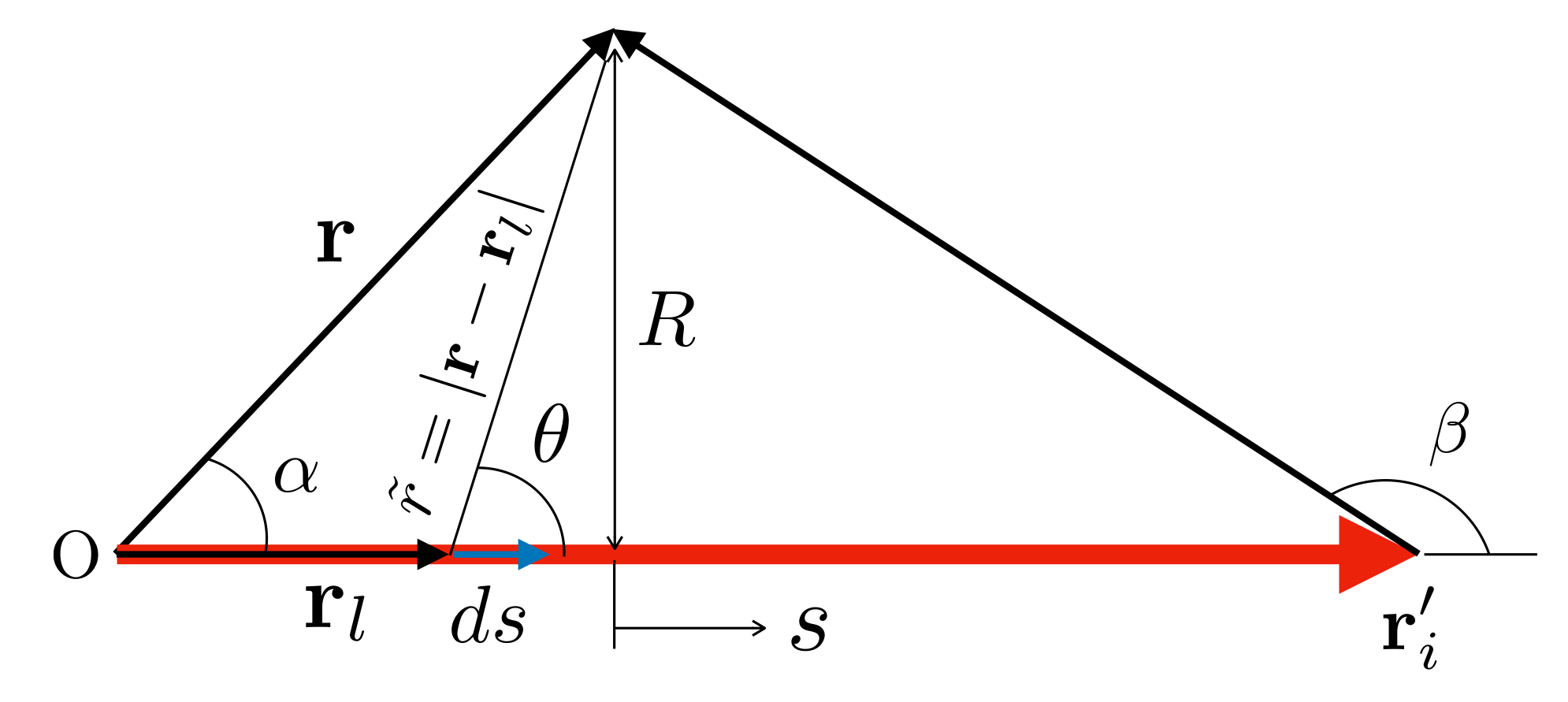
while referring Calculation of Biot-Savart field produced by uniform line vorticity. \(\mathbf{r}'_{i}\) , which directs from the origin to the position of the image vorticity for \(\boldsymbol{\omega}(\mathbf{r}')\) . Since the strength of the line vorticity is uniform, we may write the Biot-Savart integral as
(244) \[ \frac{|\boldsymbol{\omega}_{l}|}{4 \pi} \int_{C} \frac{d\mathbf{s} \times (\mathbf{r} - \mathbf{r}_{l})}{|\mathbf{r} - \mathbf{r}_{l}|^{3}}\]
Fig. 10 Calculation of Biot-Savart field produced by uniform line vorticity.
We first calculate the magnitude of the induced vorticity at \(\mathbf{r}\) . We take the origin of the coordinate \(s\) along the line vorticity as shown in the figure, for which
(245) \[ - s = \frac{R}{\tan \theta} \]
where \(R = |\mathbf{r} - ( \mathbf{r} \cdot \mathbf{e}_{r'} ) \mathbf{e}_{r'}|\)
Differentiating this equation yields
(246) \[ ds = \frac{R}{ \sin^{2} \theta } d\theta\]
The integration can therefore be carried out as follows:
(247) \[ \frac{|\boldsymbol{\omega}_{l}|}{4 \pi} \int_{C} \frac{| d\mathbf{s} \times \tilde{\mathbf{r}} |}{\tilde{r}^{3}}
= \frac{|\boldsymbol{\omega}_{l}|}{4 \pi} \int_{C} \frac{\tilde{r} ds \sin \theta}{\tilde{r}^{3}}
= \frac{|\boldsymbol{\omega}_{l}|}{4 \pi} \int_{\alpha}^{\beta} \frac{\sin \theta}{R} d\theta
= \frac{|\boldsymbol{\omega}_{l}|}{4 \pi R} \left[ - \cos \theta \right]_{\alpha}^{\beta}
= \frac{|\boldsymbol{\omega}_{l}|}{4 \pi R} \left( \cos \alpha - \cos \beta \right)\]
where \(R = \tilde{r} \sin \theta\) was used. Then, the direction of the produced vorticity element at \(\mathbf{r}\) is perpendicular to both \(\mathbf{r}'_{i}\) and \(\mathbf{r}\) , and therefore, we can write it as
(248) \[ \mathbf{e}_{r'} \times \frac{\mathbf{r} - ( \mathbf{r} \cdot \mathbf{e}_{r'} ) \mathbf{e}_{r'}}{| \mathbf{r} - ( \mathbf{r} \cdot \mathbf{e}_{r'} ) \mathbf{e}_{r'} |}
= \frac{ \mathbf{e}_{r'} \times \mathbf{r} }{R}\]
Thus, the produced vorticity at \(\mathbf{r}\) is given by
(249) \[ \frac{1}{4 \pi} \frac{ |\boldsymbol{\omega}_{l}| \mathbf{e}_{r'} \times \mathbf{r} }{R^{2}} \left( \cos \alpha - \cos \beta \right) \]
Recall that \(\boldsymbol{\omega}_{l} = |\boldsymbol{\omega}_{l}| \mathbf{e}_{r'}\) ,
(250) \[ \frac{1}{4 \pi} \frac{ \boldsymbol{\omega}_{l} \times \mathbf{r} }{R^{2}} \left( \cos \alpha - \cos \beta \right) \]
Then, \(\cos \alpha\) and \(\cos \beta\) , can be represented in the following vectorial form:
(251) \[\begin{split}\begin{split}
&\cos \alpha = \mathbf{e}_{r} \cdot \mathbf{e}_{r'} \\
&\cos \beta = \frac{(\mathbf{r} - \mathbf{r}'_{i}) \cdot \mathbf{r}'}{|(\mathbf{r} - \mathbf{r}'_{i}) \cdot \mathbf{r}'|}
\end{split}\end{split}\]
Therefore,
(252) \[ \frac{1}{4 \pi} \frac{\boldsymbol{\omega}_{l} \times \mathbf{r}}{|\mathbf{r} - (\mathbf{r} \cdot \mathbf{e}_{r'}) \mathbf{e}_{r'}|^{2}} \left( \mathbf{e}_{r} \cdot \mathbf{e}_{r'} - \frac{(\mathbf{r} - \mathbf{r}'_{i}) \cdot \mathbf{r}'}{|(\mathbf{r} - \mathbf{r}'_{i}) \cdot \mathbf{r}'|} \right)\]
By integrating all the contributions, we obtain the required result:
(253) \[ \frac{1}{4 \pi} \iiint_{V'} \frac{\boldsymbol{\omega}_{l} \times \mathbf{r}}{|\mathbf{r} - (\mathbf{r} \cdot \mathbf{e}_{r'}) \mathbf{e}_{r'}|^{2}} \left( \mathbf{e}_{r} \cdot \mathbf{e}_{r'} - \frac{(\mathbf{r} - \mathbf{r}'_{i}) \cdot \mathbf{r}'}{|(\mathbf{r} - \mathbf{r}'_{i}) \cdot \mathbf{r}'|} \right) dV'\]
See also
Sunagawa [Sun87 ] for detailed discussion on Biot-Savart law.