Potential flow about sphere
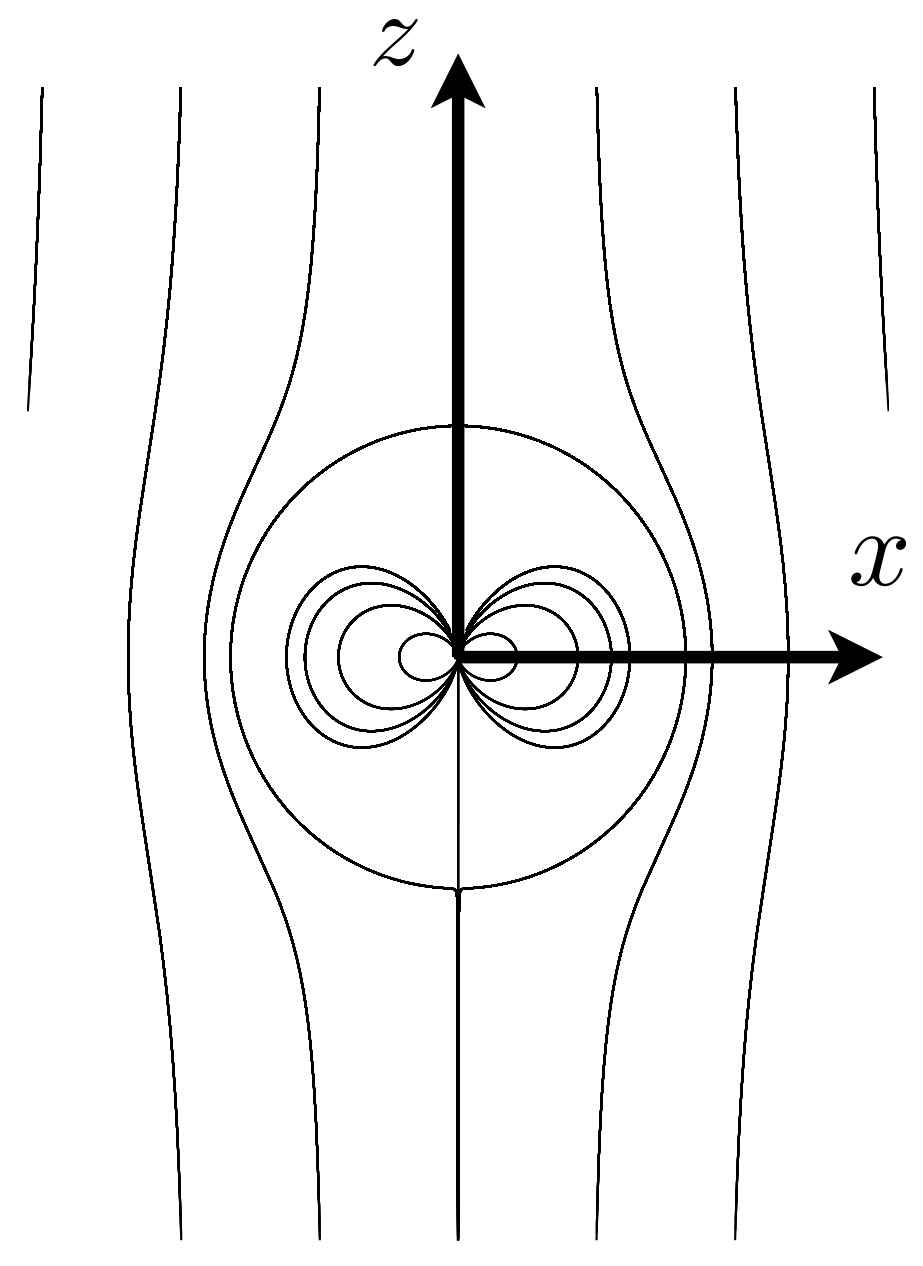
Fig. 5 Potential flow about sphere
Suppose that a fluid is uniformly flow in \(-z\) direction: \(\mathbf{v} = -u \mathbf{e}_{z}\). In the spherical polar system, \(\mathbf{v} = (- u \cos \theta, u \sin \theta, 0)\). The velocity potential for this is \(\phi = - u r \cos \theta\). \(\phi = - m / r~(m > 0)\) represents a flow having only the radial velocity component: \(\mathbf{v} = (m/r^{2}, 0, 0)\). This flow is the so-called source and \(m\) is the strength of source since \(m\) determines the volume flow rate passing through an arbitrary sphere set at the origin, i.e., \(\iint_{S} \mathbf{v} \cdot \mathbf{n} dS = 4 \pi m\). The velocity potential \(\phi = m/r\) gives a velocity field of sink of the strength \(m\). Let us consider a situation that the uniform flow is coming from the far field, the sink is set at the origin, and the source is placed on the \(z\) axis with a small distance \(\delta z\). The sum of these velocity potentials also satisfies the Laplace equation, \(\nabla^{2} \phi = 0\), because of the linearity of the equation. Therefore, we make
where \(r_{s} = r + \delta z\). Applying Taylor series expansion to the third term, we have
By taking the limit \(\delta z\), which means the source is approaching the sink, while keeping \(\lambda = m \delta z = \text{const.}\), we obtain
where \(z = r \cos \theta\) was used. The radial velocity component is given by
Given the boundary condition \(v_{r} = 0\) at \(r = a\), we get \(\lambda = u a^{3} / 2\). Hence,
There is no flow passing through the sphere of radius \(a\). Therefore, the velocity field can be regarded as a uniform flow past a sphere. By removing the velocity potential for the uniform flow, we can have a potential for the flow about a sphere moving along the \(z\) axis at \(u\):