3.3. Frictional pressure drop: Lockhart-Martinelli correlation
3.3.1. Separate flow model
Following Lockhart and Martinelli [LM49], we assume that the two-phase pressure drop can be expressed by
where the friction factors of both phases are given in the Blasius form:
The Reynolds number of the phase \(k\) is defined by
If the phase \(k\) flows alone at the mass flux \(G_{k} = \alpha_{k} \rho_{k} v_{k} = \rho_{k} j_{k}\), the pressure drop may be expressed as
since the mean velocity is given by \(G_{k} / \rho_{k} = j_{k}\).
Note
\(- | dp/dz |_{L}\) and \(- | dp/dz |_{L0}\) are different quantities!
The square root of the ratio of the liquid-phase pressure drop to the gas-phase pressure drop is the Lockhart-Martinelli parameter:
The last expression seems complex, but if we take \(n_{L} = n_{G} = 0\) and \(C_{L} = C_{G}\) under an assumption that both phases are in fully turbulent conditions we obtain
Writing the two-phase pressure drop as a product of the pressure drop of the phase \(k\) and a two-phase multiplier \(\phi_{k}\), we have
Therefore,
By obtaining \(\phi\) as a function of \(X\), we can calculate the two-phase pressure drop since \(X\) is determined by the flow condition.
3.3.2. Theoretical basis
Chisholm [Chi67] gave a theoretical basis for an empirical fit of \(\phi (X)\) as follows. The force balance in each phase is given by
where \(Pe_{k}\) is the perimeter of the phase \(k\) (\(Pe_{G} + Pe_{L} = \pi D\)), \(Pe_{i}\) is the perimeter of the gas-liquid interface, \(A_{k}\) is the cross sectional area of the phase \(k\), \(\tau_{k}\) is the wall shear stress at the contact between the phase \(k\) and the pipe wall, and \(\tau_{i}\) is the interfacial shear stress.
Summing the two equations yields
\(- \left. \frac{dP}{dz} \right|_{TP} = \tau_{G} \frac{Pe_{G}}{A} + \tau_{L} \frac{Pe_{L}}{A} = \frac{4 \tau_{G}}{4A/Pe_{G}} + \frac{4 \tau_{L}}{4A/Pe_{L}} = \frac{4 \tau_{G}}{D_{G}} + \frac{4 \tau_{L}}{D_{L}}\)
where \(D_{k}\) is the hydraulic equivalent diameter.
Factorizing the pressure gradient and interfacial friction terms gives
The ratio of the interfacial friction to the pressure drop is denoted by
and the wall shear stresses are given by the following constitutive equations:
where \(f_{k}\) is Fanning’s friction coefficient for the phase \(k\). Therefore,
Dividing the second equation with the first one and using the definition
yield
Therefore, the velocity ratio is given by
For the cases in which the two phases flow alone, the liquid pressure drop can be written as
where \(f'_{L}\) is the friction factor for the liquid phase flowing alone and \(D = 4 A_{L} / Pe'\). The two-phase multiplier is calculated from this equation and Eq. (3.29) as
Rearranging the first factor in the third equation yields
Consider the limiting case where both phases are in turbulent conditions; the friction factors are the same constant and the phase distributions are uniform, and there is no velocity slip, yielding
Using Eq. (3.22), we obtain
Thus,
where the coefficient \(C\) depends on the flow state as shown in Table 3.1, and Fig. 3.2 shows the model for each flow conditions.
Liquid/Gas |
Turbulent/Turbulent |
Laminar/Turbulent |
Turbulent/Laminar |
Laminar/Laminar |
|---|---|---|---|---|
\(C\) |
20 |
12 |
10 |
5 |
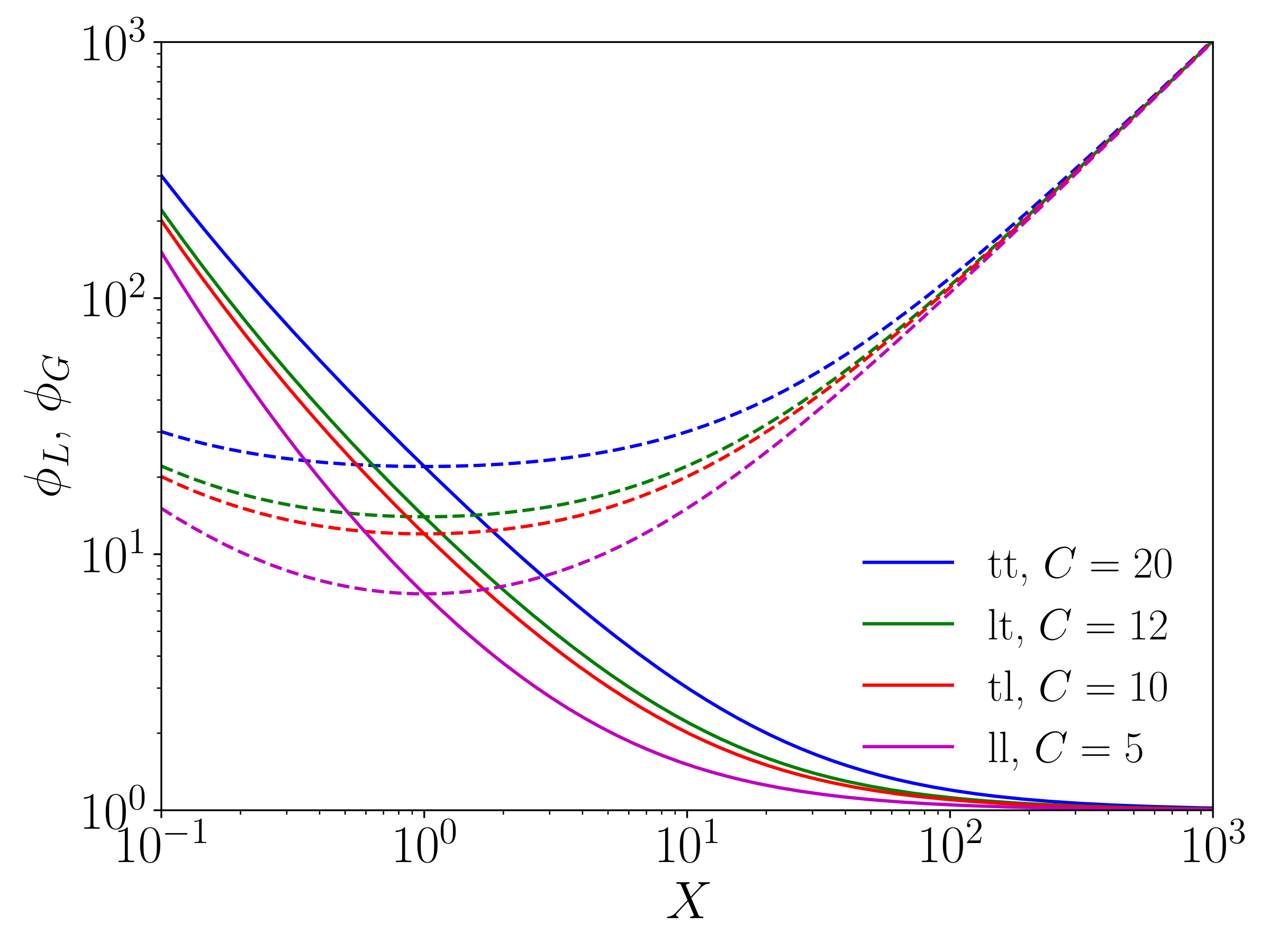
Fig. 3.2 Chisholm model for two-phase multiplier. solid line: \(\phi_{L}\), broken line: \(\phi_{G}\).