6.1. Dimensionless groups
The rise velocity of a gas bubble in still liquid is determined by the balance between four forces, i.e., the buoyancy, the inertial force, the viscous force and the surface tension force. Let \(d\) be the sphere-volume-equivalent bubble diameter, \(V_{T}\) is the terminal velocity, \(\rho\) is the density, \(\mu\) is the viscosity, \(\sigma\) the surface tension, \(g\) is the magnitude of gravitational acceleration, the subscripts \(L\) and \(G\) denote the liquid and gas phases, respectively (Fig. 6.1). The orders of the four forces can be estimated as follows:
where \(\Delta \rho = \rho_{L} - \rho_{G}\). The ratio of the inertial force to the viscous force gives the bubble Reynolds number:
Other dimensionless groups relevant to the bubble rise motion can also be defined by combining these forces, e.g.,
Some useful relationships between the dimensionless groups can be found; for example,
The drag force, \(F_{D}\), acting on a bubble balances with the buoyancy in the terminal state, so that
Arranging this equation using the dimensionless groups defined above yield
which shows that correlating the bubble velocity on the \(Re\)-\(Eo\) map as a function, \(Re = f(Eo, M)\) drawing \(Re\) curves depending on \(M\) (Fig. 6.2). It is obvious that the characteristics of the \(Re\) curve are determined by the drag coefficient, \(C_{D}\), which also depends on dimensionless groups as discussed in the following sections. By making use of Eq. (6.9), Eq. (6.11) can be rewritten as
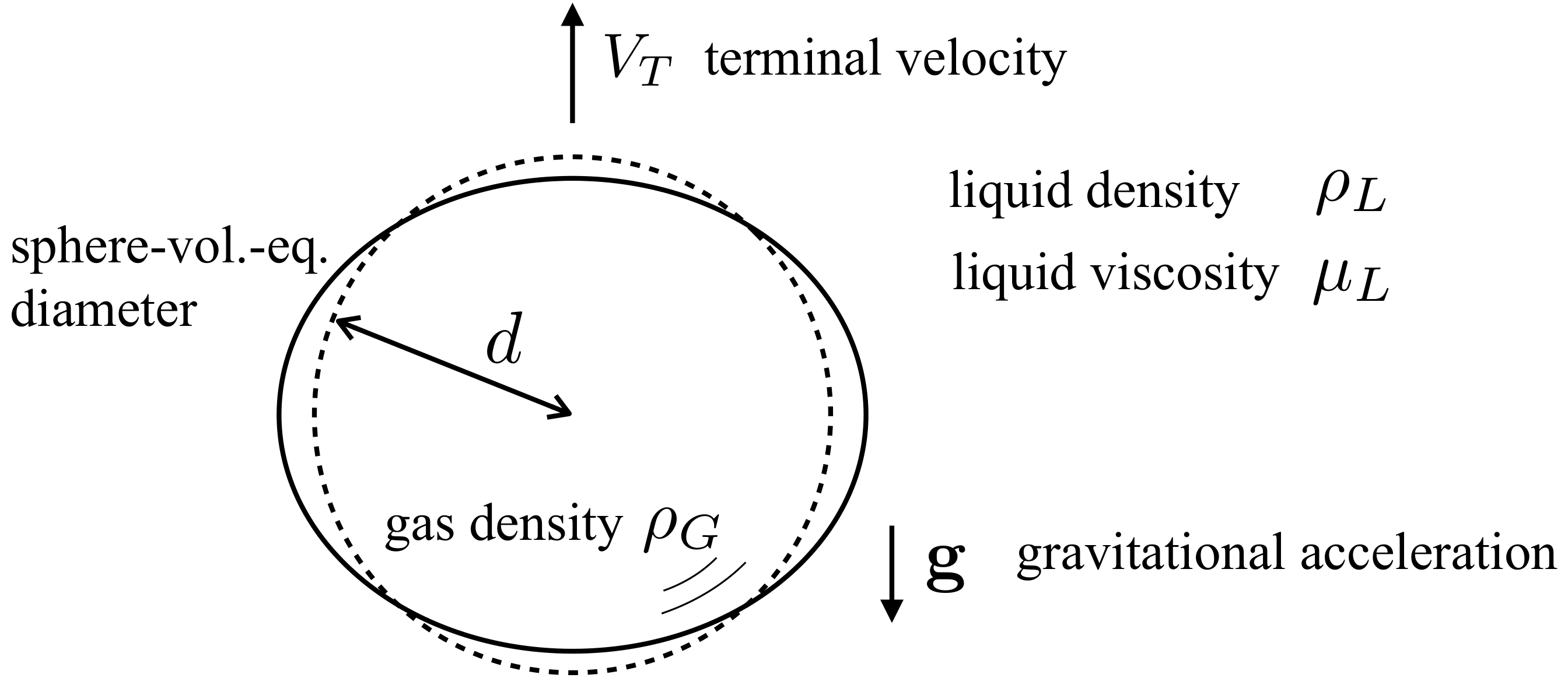
Fig. 6.1 Rising bubble in liquid
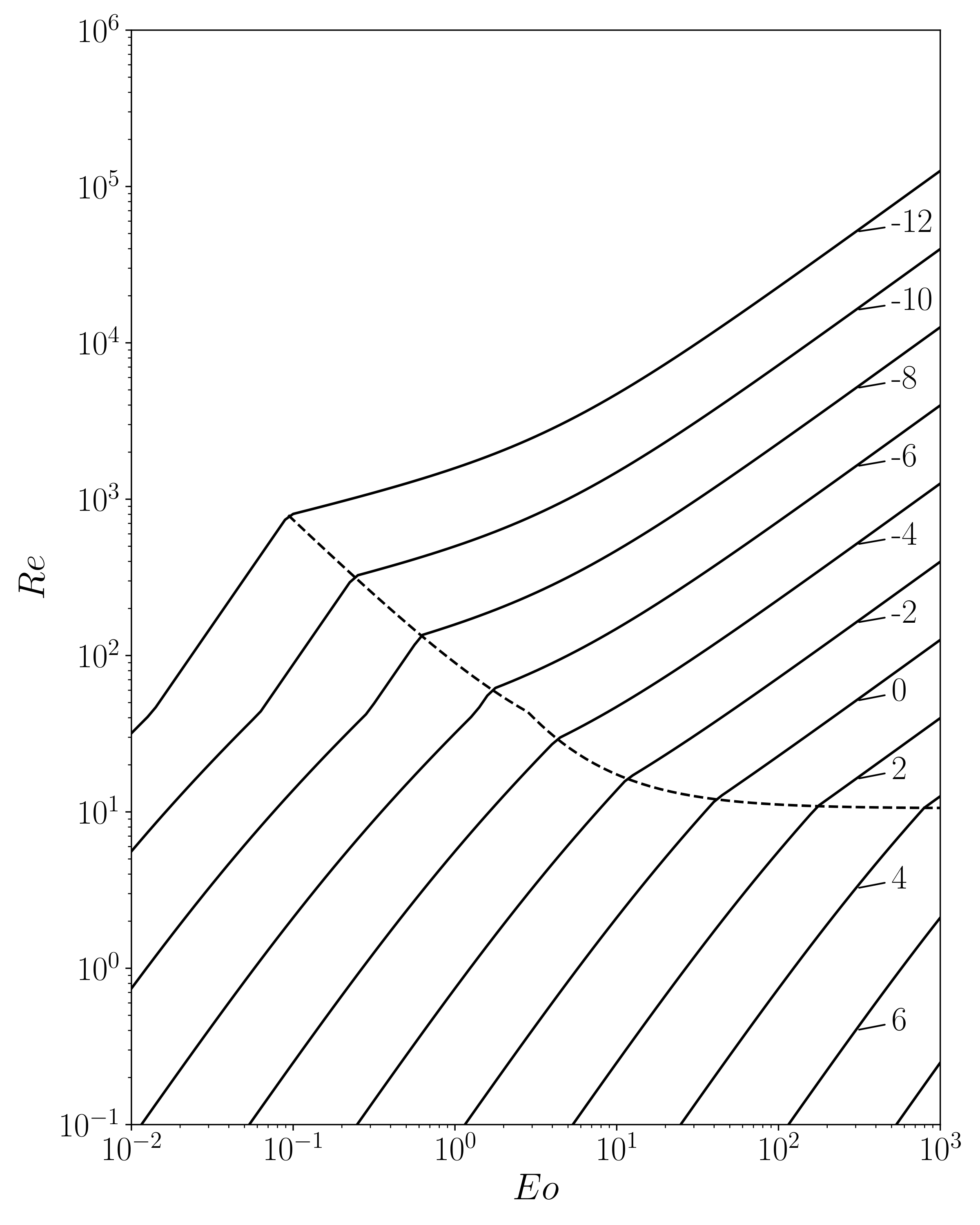
Fig. 6.2 Grace map: \(Re\) plotted as a function of \(Eo\) and \(M\). The values for each line represent \(\log M\). The curves are drawn by using a drag correlation proposed by Tomiyama et al. [TKZS98].