The perturbation is assumed to be weak, i.e., \(aA/u_{0} \ll 1\), so that only the change in vorticity by the primary flow should be considered as discussed in Eq. (9.113). The primary flow is expressed by the stream function in Eq. (9.108). The streamlines can also be written in the following form:
(206)¶\[ y = y(x, y_{0}, z_{0}),~~~~z = z(x, y_{0}, z_{0})\]
Since the flow is steady, a streamline given for \((y_{0}, z_{0})\) can be considered as the particle path of a fluid particle initially at \((- \infty, y_{0}, z_{0})\). The additional variable \(t\), the so-called \textit{drift function}, is then introduced:
(209)¶\[ t - \frac{x}{u_{0}} \rightarrow 0~~~~\text{as}~x \rightarrow - \infty\]
A surface of \(t = \text{const.}\) far upstream of the sphere consists a material plane perpendicular to the \(x\) axis. As approaching the sphere from far upstream, fluid particles around the \(x\) axis become slower than those far from the sphere, resulting in deformation of the material surfaces of \(t = \text{const.}\). See Darwin (1953) for more detail about \text{drift}.
As we saw in Eq. (196), the vorticity is changed by stretching of associated fluid element. The stretching of fluid element can be expressed in terms of the change in the distance between two neighbors having same \(t\). Let us take a fluid element joining \((y_{0}, z_{0})\) and \((y_{0}, z_{0} + \delta z_{0})\) in the far upstream and denote the displacement between these fluid particles at later time as \(\delta \mathbf{r}~(= \delta x, \delta y, \delta z)\). The fluid element is stretched with the factor of \(|\delta \mathbf{r}| / \delta z_{0}\) and the vorticity lies along the new position of the fluid element, so that the vorticity is give by
was used; the temporal change in the \(x\) position of a fluid particle specified by \((y_{0}, z_{0})\) is its velocity component in the \(x\) direction. For the differentiation \(dy\),
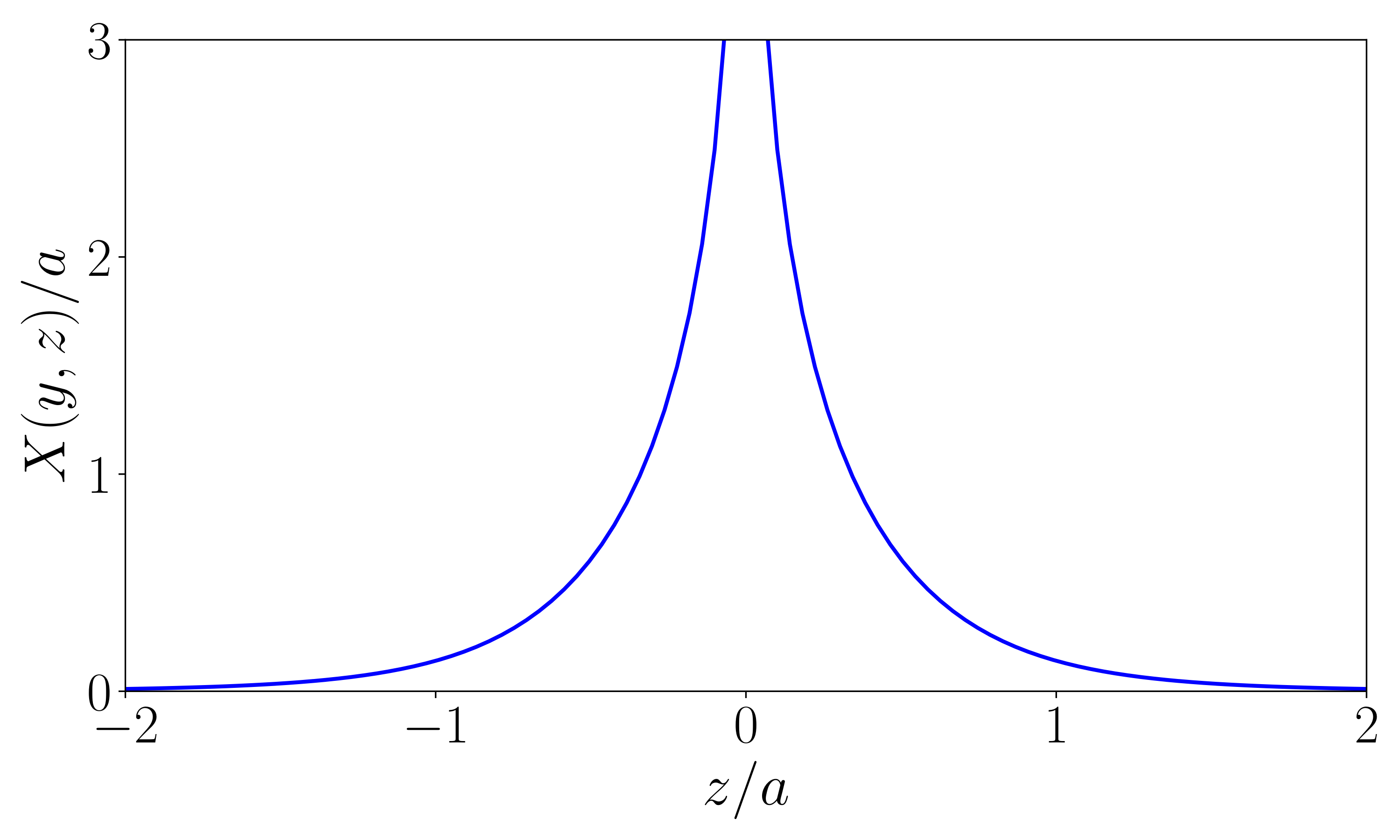
where \(X(x, y)\) is the so-called \textit{total drift}, which explains that the ultimate displacement of a fluid particle relative to fluid particles initially in the same plane, but far from the \(x\) axis (Fig. 8).
The sum of the total drift is known to be the same as the virtual mass: (derived by Darwin, 1953)
In this limit, \(\left( \partial y / \partial z_{0} \right)_{x, y_{0}}\) goes to zero, so that \(\omega_{y} \rightarrow 0\). Then, \(\left( \partial z / \partial z_{0} \right)_{x, y_{0}} \rightarrow 1\), giving \(\omega_{z} \rightarrow -A\). These results show that \(\omega_{y}\) and \(\omega_{z}\) recovers the far upstream values. On the other hand, \(\omega_{x}\) becomes non-zero even in far downstream, that is, the new component is
(220)¶\[ \omega_{x} \rightarrow A \frac{\partial X}{\partial z}\]
Fig. 8 Total drift \(X(0,z)\). For a sphere moving steadily in stagnant fluid, fluid particles are taken away from their initial positions by the motion of the sphere.
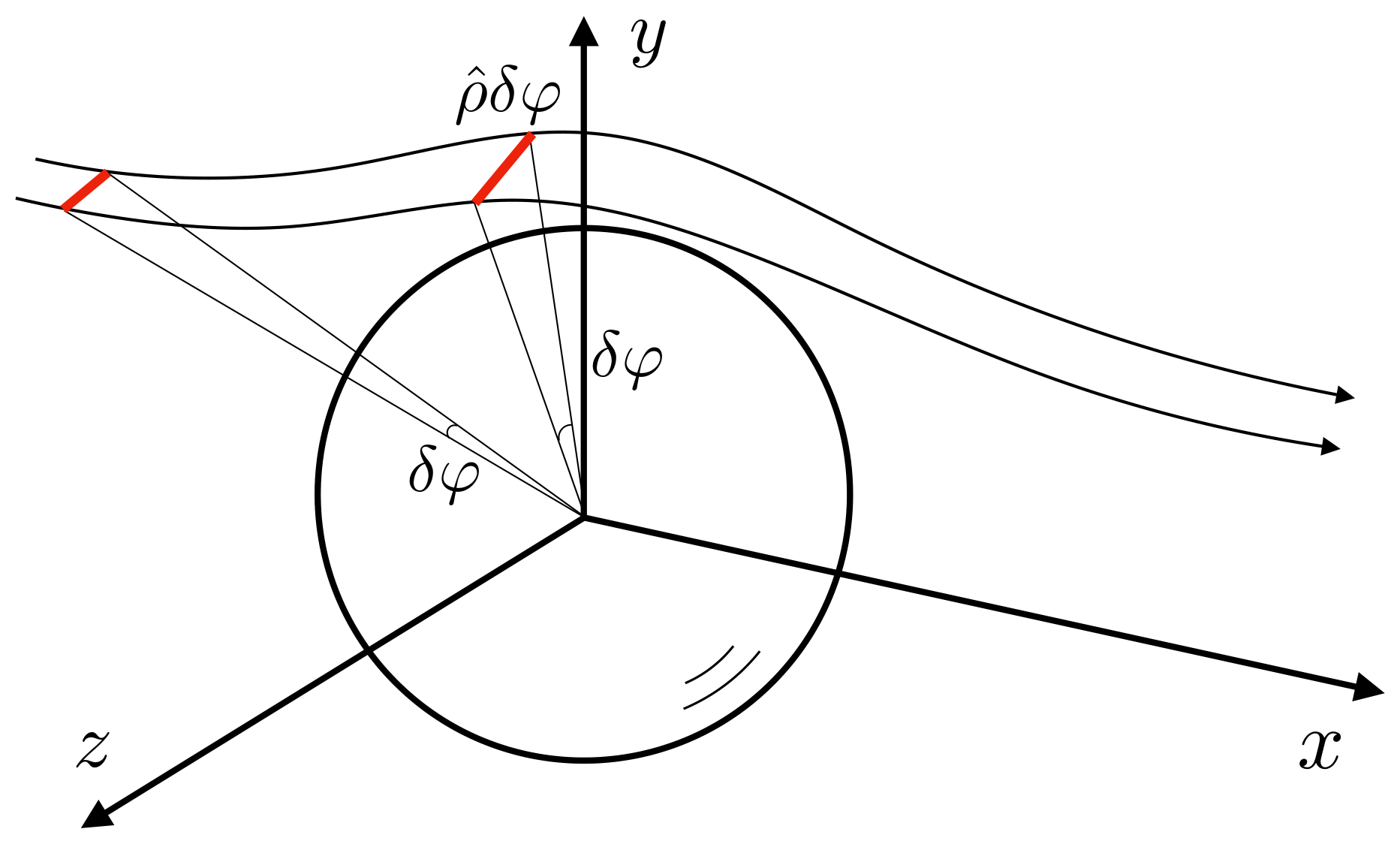
Fig. 9 Ring vorticity \(\omega_{\varphi}\) always lie on the \(\varphi\) coordinate.
Lighthill also showed the vorticity components in the polar systems. With the cylindrical coordinates \((\hat{\rho}, \varphi, x)\)
(221)¶\[ y = \hat{\rho} \cos \varphi,~~~~z = \hat{\rho} \sin \varphi\]
The initial vorticity of the oncoming shear flow is
(222)¶\[ \left( \omega_{x}, \omega_{\hat{\rho}}, \omega_{\varphi} \right)
= \left( 0, - A \sin \varphi, - A \cos \varphi \right)~~~~\text{as}~x \rightarrow -\infty\]
Considering axial symmetry of the primary flow, a fluid element along the \(\varphi\) coordinate line does not change its angle \(\delta \varphi\), so that the stretching of the fluid element is simply expressed as \(\hat{\rho} \delta \varphi / \hat{\rho}_{0} \delta \varphi = \hat{\rho} / \hat{\rho}_{0}\) (Fig. 9). Therefore,
(224)¶\[ x = r \cos \theta,~~~~\hat{\rho} = r \sin \theta\]
we have
(225)¶\[ \omega_{\varphi} = -A \cos \varphi \frac{r \sin \theta}{\hat{\rho}_{0}}\]
Then, we consider a fluid element joining streamlines \((\hat{\rho}_{0}, \varphi)\) and \((\hat{\rho}_{0} + \delta \hat{\rho}_{0}, \varphi)\). The \(\hat{\rho}\) component of the initial vorticity is given in Eq. (222), i.e., \(-A \sin \varphi\). The fluid element, whose length is initially \(\delta \hat{\rho}_{0}\), may become \(\delta r \mathbf{e}_{r} + r \delta \theta \mathbf{e}_{\theta}\) in the plane of constant \(\varphi\). The vorticity associated with \(\delta \hat{\rho}\) is therefore