10.1. Large bubbles in liquid
Summary
Subject: Rise velocity of spherical-cap bubble
Main conclusion: A large bubble taking a spherical-cap shape and its velocity is proportional to \(\sqrt{g a}\), where \(a\) is the cap radius.
Key idea Potential flow theory can be applied to fluid particles on the front of a spherical-cap bubble of high \(Re\) although the flow behind the bubble (wake) may be highly turbulent.
Reference:
A bubble in a liquid can keep its shape spherical when its size is small. The inertial force becomes stronger as the bubble size increases and the surface tension cannot maintain the sphericity of the bubble shape. In particular, a shape like an umbrella or a slice of a sphere is formed when a bubble is larger than a certain size. They are called spherical-cap bubbles. Cap bubbles tend to rise rectilinearly in stagnant liquid. The front shape can be approximated by a sphere of radius \(a\) and is stable during the rise motion. On the other hand, the rear shape is flattened and surface waves are formed on the rear surface. The liquid flow may separate at the edge of the cap shape and turbulent stresses play an important role in the wake behind the bubble. The wake angle \(\theta_{w}\) is defined as the angle measured from the bubble nose to the edge. The bubble shape is therefore characterized by \(a\) and \(\theta_{w}\). However, the sphere-volume-equivalent diameter \(d\) would be useful when considering the drag coefficient. The volume of the cap bubble is given by
where the center of the sphere of \(a\) is located at the origin of the spherical coordinates \((r, \theta, \varphi)\) and the bubble nose is set at \(z = a\). The bubble volume is also written as \(V = \pi d^{3} / 6\). Therefore,
For \(Re > 150\), \(\theta_{w} \sim 50^{\circ}\) [CGW78], so that \(d \sim 0.877 a\), where the Reynolds number is defined for \(d\) as the length scale:
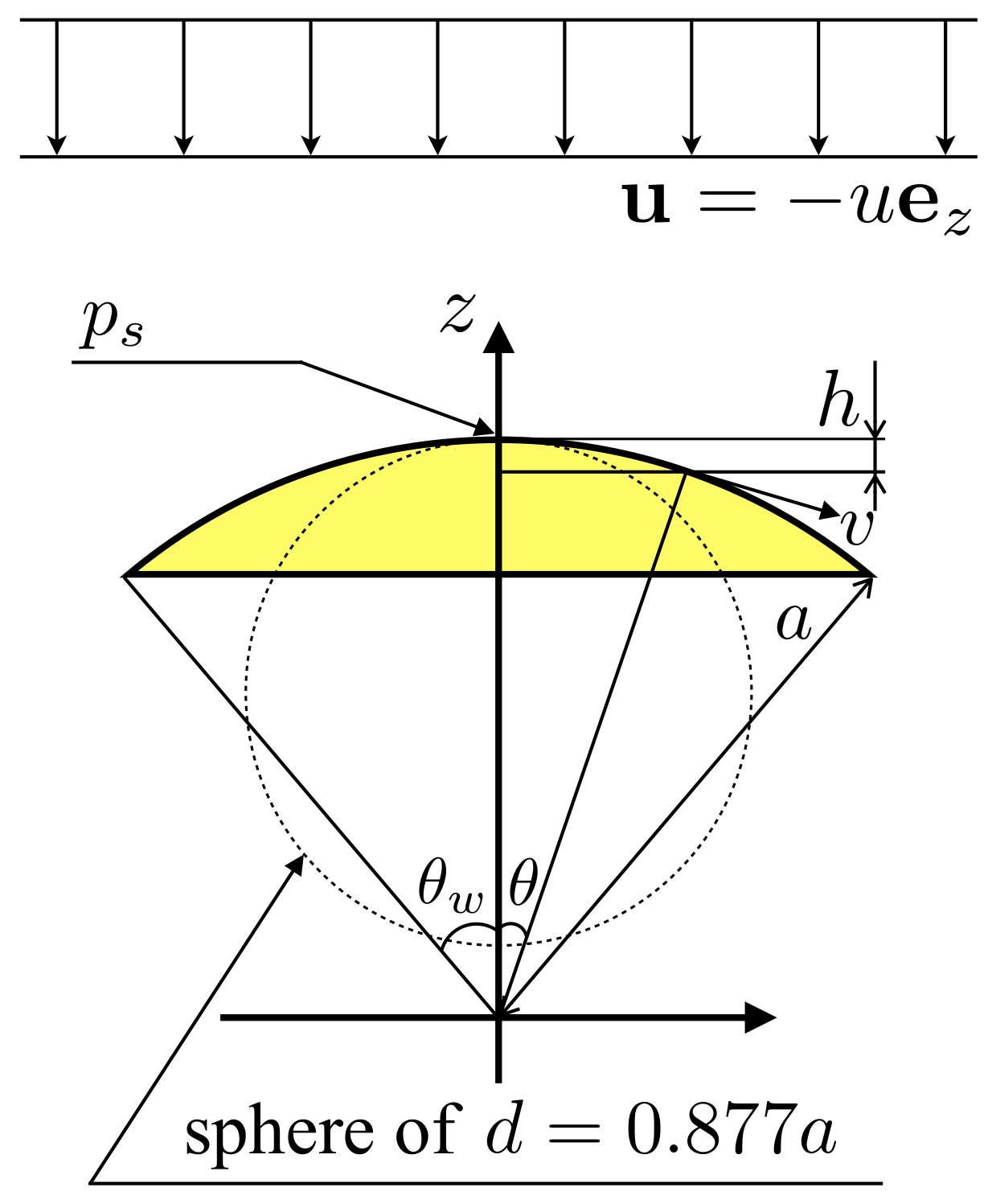
Fig. 10.1 Spherical-cap bubble
Suppose that a spherical cap bubble rises rectilinearly through the liquid at a constant speed \(u\). Let us use the spherical coordinate system fixed at the bubble center, so that the liquid motion in the far field is \(\mathbf{u} = - u \mathbf{e}_{z}\) as we considered for the Stokes drag. At the bubble nose \((z = a)\), the liquid flow is stagnant and the liquid stagnation pressure is denoted by \(p_{s}\). Bernoulli’s theorem for the bubble nose and a point on the \(\varphi\) coordinate line of \(z = a - h\) gives
The gas pressure \(p_{g}\) at the stagnant point balances with the sum of the liquid pressure and the surface tension, i.e.,
where \(\sigma\) is the surface tension. The gas density is negligibly small compared to \(\rho\), and therefore the gas pressure at \(z = a - h\) can also be considered as \(p_{g}\). Hence,
Therefore,
Substituting this relation into Eq. (10.4) yields
The flow filed is not irrotational. However, because of large \(Re\) and the slip boundary condition at the bubble surface, the velocity of the surface flow on the front cap can be approximated with the potential flow theory, that is,
Thus
By taking the limit \(\theta \rightarrow 0\), we may write \(\sin^{2} \theta \sim \theta^{2}\) and \(1 - \cos \theta = 2 \sin^{2} (\theta/2) \sim \theta^{2} / 2\). As a result,
Let us consider a more general situation that the gas density \(\rho_{g}\) has some effect on the gravitational term, but the gas dynamic pressure is negligible. In this case,
The first term is the normal stress balance and the second term is due to the potential energy with non-negligible \(\rho_{g}\). Subtracting this from Eq. (10.5) yields
Combining this result with the Bernoulli equation for the liquid gives
and
where \(\Delta \rho = \rho - \rho_{g}\).
The force balance between the buoyancy and the drag is given by
It should be noted that \(C_{D}\) is defined as \(C_{D} = F_{D} / (\frac{1}{2} \rho u^{2} \frac{\pi d^{2}}{4})\). Solving this for \(C_{D}\) gives
By substituting Eq. (10.15) into this expression, we have
With help of the geometric relationship Eq. (10.2) we obtain
This is comparable to the following well-known drag correlation [IC79]: