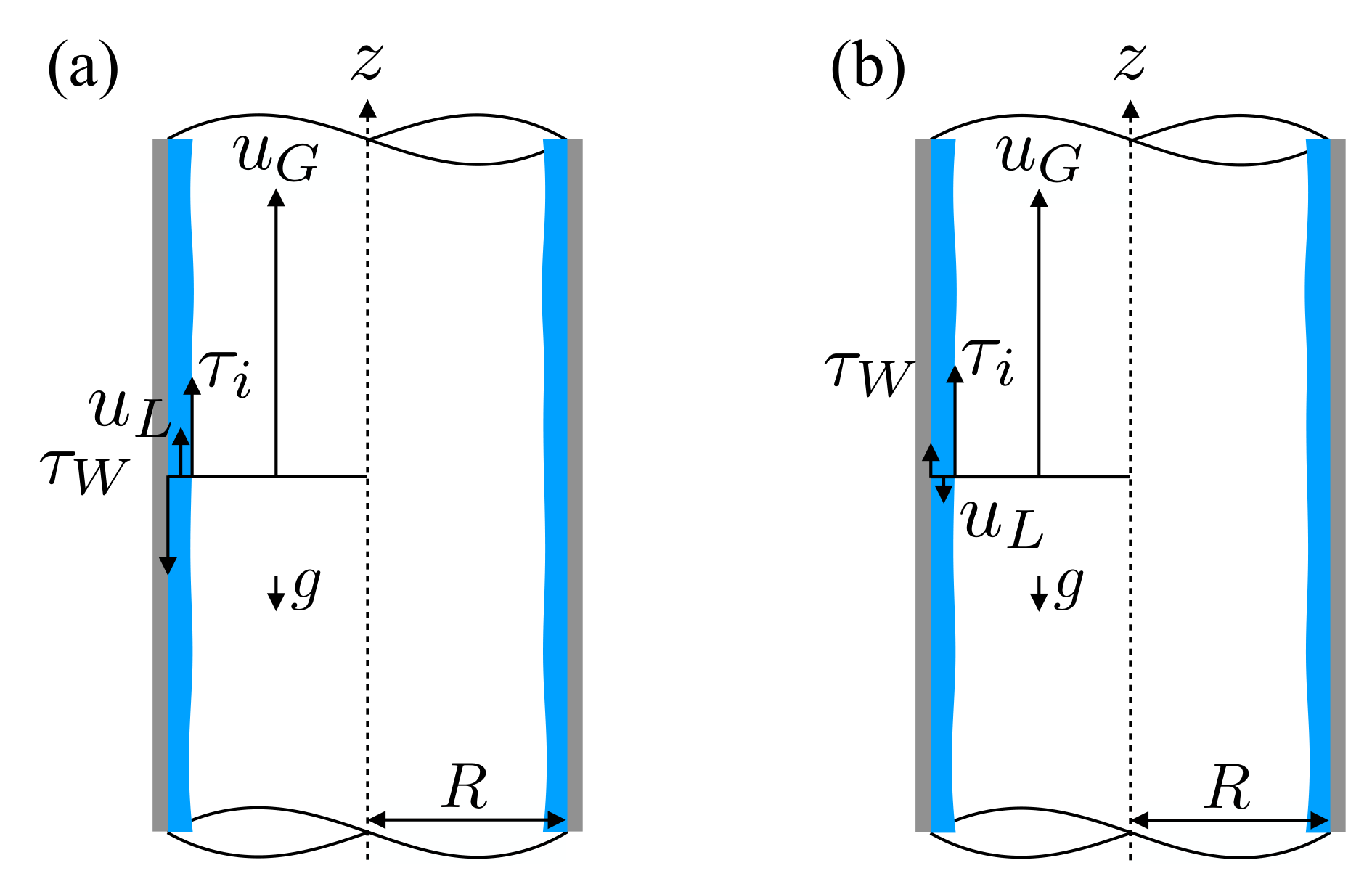
4.1. Upward co-current annular flowSuppose that the gas and liquid phases flow upward in a vertical pipe of radius \(R~(=D/2)\) as shown in Fig. 4.1
(4.1) \[\begin{split}\begin{split}
&- \alpha_{G} \left. \frac{dp}{dz} \right|_{TP} - \tau_{i} \frac{Pe_{i}}{A} - \alpha_{G} \rho_{G} g = 0 \\
&- \left. \frac{dp}{dz} \right|_{TP} A_{L} + \tau_{i} Pe_{i} - \rho_{L} g A_{L} - \tau_{W} Pe_{W} = 0
\end{split}\end{split}\]
where
(4.2) \[\begin{split}\begin{split}
&A = \pi R^{2} \\
&A_{G} = \pi ( R - \delta )^{2} \\
&A_{L} = A - A_{G} \\
&Pe_{W} = 2 \pi R \\
&Pe_{i} = 2 \pi (R - \delta) = 2 \pi R \sqrt{\alpha_{G}}
\end{split}\end{split}\]
and \(\delta\) is the mean liquid film thickness. We employ the following expressions for the interfacial and wall frictions:
(4.3) \[\begin{split}\begin{split}
&\tau_{i} = f_{i} \frac{\rho_{G}}{2} (u_{G} - u_{L})^{2} \\
&\tau_{W} = f_{W} \frac{\rho_{L}}{2} u_{L}^{2}
\end{split}\end{split}\]
Thus,
(4.4) \[\begin{split}\begin{split}
&- \alpha_{G} \left. \frac{dp}{dz} \right|_{TP} - f_{i} \frac{\rho_{G}}{2} (u_{G} - u_{L})^{2} \frac{2 \pi R \sqrt{\alpha_{G}}}{A} - \alpha_{G} \rho_{G} g = 0 \\
&- \alpha_{L} \left. \frac{dp}{dz} \right|_{TP} + f_{i} \frac{\rho_{G}}{2} (u_{G} - u_{L})^{2} \frac{2 \pi R \sqrt{\alpha_{G}}}{A} - \alpha_{L} \rho_{L} g - f_{W} \frac{\rho_{L}}{2} u_{L}^{2} \frac{Pe_{W}}{A} = 0
\end{split}\end{split}\]
For a given set of the volume flow rates,
(4.5) \[\begin{split}\begin{split}
&u_{G} = \frac{Q_{G}}{A_{G}} \\
&u_{L} = \frac{Q_{L}}{A_{L}} \\
\end{split}\end{split}\]
Therefore, we can obtain \(- \left. dp/dz \right|_{TP}\) and \(\alpha_{G}\) by solving the momentum equations, provided that the friction factors are given.
Fig. 4.1 Simple model of annular flow.
Being similar to single-phase flows, the wall friction factor is often given by the following functional form:
(4.6) \[ f_{W} = \frac{a}{Re_{L}^{n}}\]
where \(Re_{L}\) is the liquid Reynolds number defined by
(4.7) \[ Re_{L} = \frac{\rho_{L} j_{L} D}{\mu_{L}}\]
For example, Wallis [Wal70 ] used the following expression:
(4.8) \[\begin{split} f_{W} =
\left\{
\begin{array}{ll}
\frac{16}{Re_{L}} &\text{for}~Re_{L} \le 2300 \\
\frac{0.079}{Re_{L}} & \text{otherwise}
\end{array}
\right.\end{split}\]
The interfacial friction factor is considered to be a function of \(\delta\) , e.g., [Wal69 ]
(4.9) \[ f_{i} = 0.005 \left( 1 + 150 \frac{\delta}{R} \right)\]
When \(\delta \ll R\) , \(\alpha \sim 1 - 2 \delta / R\) ; therefore,
(4.10) \[ f_{i} = 0.005 \left( 1 + 75 (1 - \alpha_{G}) \right)\]
From Eq. (4.1) ,
(4.11) \[ \tau_{i} = \frac{R}{2} \sqrt{\alpha_{G}} \left( - \left. \frac{dp}{dz} \right|_{TP} - \rho_{G} g \right)\]
By summing the two in Eq. (4.1) , we obtain the global balance equation:
(4.12) \[ \tau_{W} = \frac{R}{2} \left( - \left. \frac{dp}{dz} \right|_{TP} - \rho_{m} g \right)\]
where \(\rho_{m} = \alpha_{G} \rho_{G} + \alpha_{L} \rho_{L}\) . Eliminating the pressure drop yields
(4.13) \[ \tau_{i} = \sqrt{\alpha_{G}} \tau_{W} + \frac{R}{2} \sqrt{\alpha_{G}} \left( \rho_{m} - \rho_{G} \right) g\]
or
(4.14) \[ \tau_{i} = \sqrt{\alpha_{G}} \tau_{W} + \frac{R}{2} \sqrt{\alpha_{G}} \alpha_{L} \Delta \rho g\]
where \(\Delta \rho = \rho_{L} - \rho_{G}\) . The liquid film is, thus, suspended by the interfacial friction. Using (4.3) and evaluating \(\tau_{W} \sim \mu_{L} u_{L} / \delta\) give
(4.15) \[ f_{i} \frac{\rho_{G}}{2} (u_{G} - u_{L})^{2} = \sqrt{\alpha_{G}} \mu_{L} \frac{u_{L}}{\delta} + \frac{R}{2} \sqrt{\alpha_{G}} \alpha_{L} \Delta \rho g\]
(4.16) \[ u_{G} - j = \left[
\frac{2 D \sqrt{\alpha_{G}}}{\alpha_{L} \delta f_{i}} \left(
1 + \alpha_{L}^{2} \frac{\Delta \rho g D \delta}{4 \mu_{L} j_{L}} \right)
\right]^{1/2} \left( \frac{\mu_{L} j_{L}}{\rho_{G} D} \right)^{1/2}
+ ( u_{L} - j )\]
This can be the basis of the drift velocity as shown in Table 2.1