4.2. Counter-current annular flow
When the liquid phase flows downward (Fig. 4.1(b)), the sign of the wall shear stress changes; that is,
(4.17)¶\[\begin{split}\begin{split}
&- \alpha_{G} \left. \frac{dp}{dz} \right|_{TP} - \tau_{i} \frac{Pe_{i}}{A} - \alpha_{G} \rho_{G} g = 0 \\
&- \alpha_{L} \left. \frac{dp}{dz} \right|_{TP} + \tau_{i} \frac{Pe_{i}}{A} - \alpha_{L} \rho_{L} g + \tau_{W} \frac{Pe_{W}}{A} = 0
\end{split}\end{split}\]
Being similar to the case of co-current annular flow, we obtain the relationship between the interfacial and wall shear stresses as
(4.18)¶\[ \tau_{i} + \sqrt{\alpha_{G}} \tau_{W} = \frac{R}{2} \sqrt{\alpha_{G}} \alpha_{L} \Delta \rho g\]
Here, the shear stresses work together to balance with the gravitational force. When \(u_{L} = \tau_{W} = 0\),
(4.19)¶\[ Fr_{G}^{2} \left(= \frac{u_{G}^{2}}{\Delta \rho g D / \rho_{G}} \right) = \frac{\sqrt{\alpha_{G}} \alpha_{L}}{2 f_{i}} \]
This relation of the gas Froude number gives a critical gas velocity for suspending the liquid phase (no mean liquid flow rate) by the gas blow only. Substituting the Wallis correlation for \(f_{i}\) gives
(4.20)¶\[ Fr_{G}^{2} = \frac{\alpha_{L} \sqrt{1 - \alpha_{L}}}{0.01 (1 + 75 \alpha_{L})}\]
The dependence of \(Fr_{G}\) on \(\alpha_{L}\) is shown in Fig. 4.2.
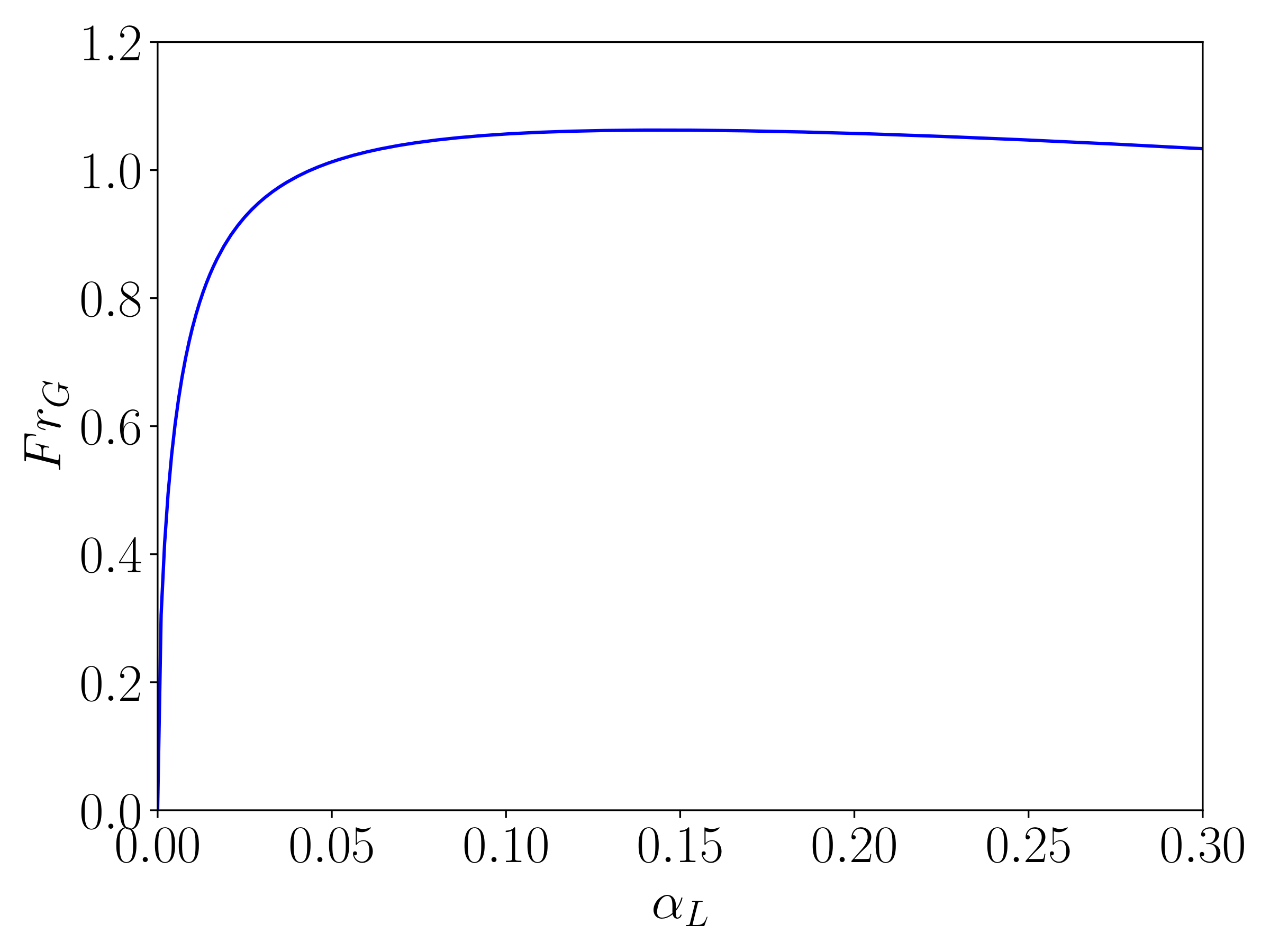
Fig. 4.2 Critical gas Froude number to suspend the liquid phase.